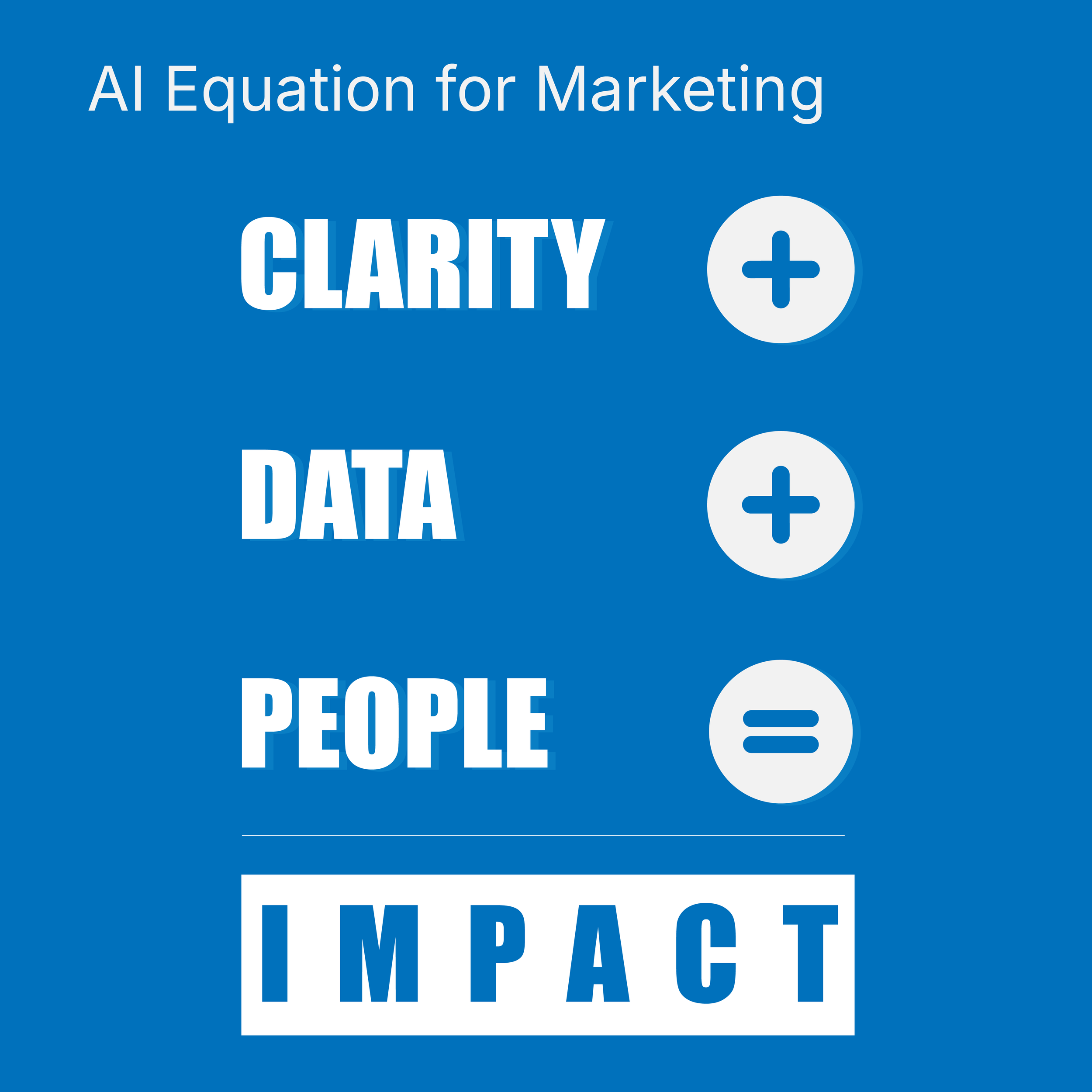
“Just put it in AI.”
I’ve been hearing that phrase more and more lately.
Need a campaign idea?
Put it in AI.
Need messaging?
Put it in AI.
Need a strategy?
Put it in AI.
Speed has become the headline. But speed has never been the real goal of marketing. Results are.
Recently I’ve been working through a certification in AI for marketing. The course confirmed something that quickly became clear when I started incorporating AI into my workflows:
The list of inputs required to produce a meaningful result is… long.
Audience definition.
Goals.
Context.
Data sources.
Tone.
Constraints.
Desired outcomes……..
The more specific the inputs, the stronger the output. This is the exact same challenge marketers have always had. AI didn’t remove the need for clarity. It simply made it impossible to ignore.
AI doesn’t create clarity. It reflects it.
The quality of AI output will always be limited by the clarity of the thinking behind it. AI is an extraordinary capability. I use it. My teams use it. And when applied well, it can accelerate research, ideation, and execution. But AI does not replace the work that determines whether marketing succeeds.
If the input is vague, the output will be vague.
If the strategy is unclear, the content will be unfocused.
If the data is weak, the conclusions will be shallow.
Sound familiar to my fellow marketers? AI amplifies thinking. Which means the real advantage still belongs to the marketers who think deeply about the market, the customer, and the outcomes they want to drive.
The data still comes first.
After more than two decades working inside the energy industry, one thing has become very clear to me: The problems we’re solving are complex.
The stakes are high.
And clarity isn’t optional.
One of the ongoing challenges in marketing is maintaining discipline around starting with data.
Not assumptions.
Not internal opinions.
Not the loudest voice in the room.
Data.
Real customer behavior.
Market signals.
Adoption patterns.
Competitive context.
AI can help analyze information. But it cannot replace the responsibility of marketers to define what matters and why it matters.
Great marketing has always been about translation
Turning complex problems into clear narratives.
Turning technical capabilities into human value.
Turning data into strategy.
AI can accelerate parts of that process. But it cannot replace the leadership required to bring clarity to it. The organizations that succeed with AI will not be the ones moving the fastest. They’ll be the ones with the clearest understanding of their customers, their markets, and the outcomes they are trying to drive
Because in the end:
AI is powerful.
But clarity is still the competitive advantage.
I’m curious how others are seeing this play out in their organizations. Where have you found clarity matters most before AI can actually be useful in marketing?