

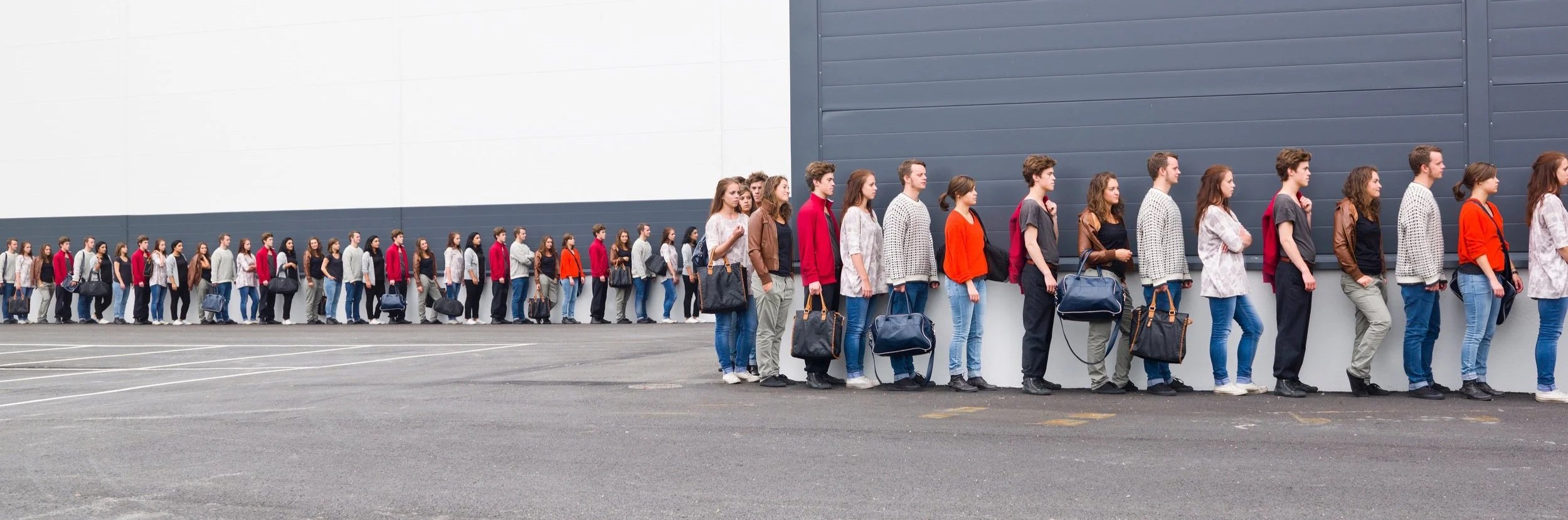
The grid is starting to feel like a grocery store with one checkout lane open. And the line is getting longer by the day.
For decades, the electric grid operated like a small-town grocery store.
One store.
Predictable traffic.
Just enough checkout lanes.
Then the population changed.
Not gradually. All at once.
Now imagine that same store with 2–3x the customers showing up overnight.
New customers.
Different buying patterns.
Bigger carts.
Now there’s a line to get in.
A line to shop. And a very long line to check out.
That’s the energy industry right now.
The Line No One Can Ignore
We talk a lot about:
generation
transmission
clean energy
But the real bottleneck is simpler:
Getting through the line.
This isn’t just slowing projects down.
It’s starting to reshape how the largest energy users think about power altogether.
The interconnection queue has quietly become one of the biggest constraints in the industry.
And it’s not just about volume.
The latest NERC assessment makes it clear:
Emerging large loads aren’t just adding demand.
They’re introducing new behaviors, risks, and complexity the system wasn’t designed for.
Why the Line Moves So Slowly
From the outside, it looks like inefficiency.
Why can’t we just move faster?
Because every “customer” in line isn’t just buying groceries.
They’re bringing something that could impact the entire system.
That checkout lane isn’t just slow.
It’s where the system decides whether what’s in the cart is safe to put on the grid. And increasingly, those decisions are being made with incomplete data, evolving assumptions, and limited visibility into how these loads will actually behave on the system.
The NERC report points to gaps across:
interconnection processes
data sharing and visibility
planning and forecasting
operational coordination
And concludes that existing approaches are not adequate for this new wave of large loads.
In many cases, the store can’t fully see what’s in the cart until it reaches the register.
And the store, the suppliers, and the delivery trucks aren’t always talking to each other.
So the line isn’t slow by accident.
It’s slow because the system is trying to manage risk with tools built for a different era.
Meanwhile… Innovation Is Happening in the Aisles
There’s no shortage of innovation.
We’re seeing solutions for:
efficiency
cooling
AI infrastructure
load optimization
But most of it is happening inside the store.
It helps customers shop faster.
It might even get them to the checkout line faster.
But it doesn’t increase the number of checkout lanes.
So Customers Start Looking for Another Option
When the line gets long enough, behavior changes.
Customers stop asking,
“How do I move faster?”
And start asking,
“Why am I waiting at all?”
That’s what we’re seeing with:
behind-the-meter generation
co-located power
private energy strategies
Self-checkout.
Or more accurately:
Customers building their own store.
Not because they want to leave the system, but because they need certainty the system can’t yet provide.
And in many cases, they can build their entire operation before the system has time to open another checkout lane.
This Isn’t a Queue Problem. It’s a System Problem.
This system was designed for:
predictable growth
known behaviors
long timelines
It’s now being pushed by:
rapid, large-scale demand
dynamic load profiles
compressed development cycles
The result?
Not just congestion.
Misalignment.
And importantly, these customers aren’t behaving irrationally.
They’re responding to demand, capital, and timelines that no longer align with how the system was built.
The Real Question
It’s not: How do we move the line faster?
It’s: How do we redesign the system so the line works at all?
Because if we don’t…
The biggest customers won’t wait. They’ll redesign how they access power entirely. It’s already happening.
And the industry won’t just be managing a longer line. It will be managing a different system.
One Question for My Energy Colleagues
Where are you focused right now?
Helping customers shop more efficiently?
Getting them to the line faster?
Or actually increasing the number of checkout lanes?
Curious how others are thinking about this 👇